Showing posts with label silver age. Show all posts

Saturday, February 28, 2009

A problem with legacy heroes

In theory, I don't have a problem with legacy heroes--by which I mean the custom of having more than one hero with the same name. I'm more than capable of enjoying (for example) Alan Scott, Kyle Rayner and Guy Gardner, as well as many other Green Lanterns. (Granted that the Green Lantern corps structure makes GL an easily-legacied role.) It can be a little clumsy, as I think they've even recognized in the comics themselves (when Wildcat's son was introduced, he and his dad had a little discussion about codenames where Wildcat assumed they'd just both go by Wildcat), but generally it's apparent from the context. Well, okay, so one guy in a Flash suit looks pretty much like any other guy in a Flash suit. But it's not a huge problem for me.

However, it can be a problem when the "legacies" are seen less as characters themselves than as adjuncts of older characters. It can make them automatically second-tier heroes purely because they came later. It doesn't have to do this. However.

This interview with Dan Didio has a few statements that make me a little uneasy. Here are a couple of bits from it:

One of the things that we’re doing right now is that we’re looking through our list of character’s origins and are finding what we think is the clearest interpretation and the one that’s the easiest to explain. That way, we can carry on with their stories without getting bogged down with all the continuity that put other characters in their place.

What I’m basically saying is that the defining origin is the one. Think of the Flash – you don’t know Wally or Bart’s origin without Barry’s first. You don’t know Kyle or Guy’s origin without understanding Hal’s origin first.


and then there's this one:

11. So there’s still a role for the second generation characters who took the role while their mentors were not in it?

DD: There will be an enormous role for them moving forward. There’s a big role for them now – Kyle is in Green Lantern Corps, so he’s never been marginalized; Wally and Connor, and even Cassandra Cain will be appearing throughout the year, and will be seen in roles where they really have a chance to shine.

Or be dragged through the mud, depending on how you approach it.


Now, I'm of an age where, by rights, I ought to be a Hal/Barry era fan. However, since I was almost wholly a Marvel girl in my formative years and didn't really get into DC until much later, I am in fact a Kyle/Wally era fan. I've tried to like Hal--well, I don't dislike him, but I just can't muster the interest in the character to want to buy his book. (I'd buy John, I'd buy Guy, I'd buy Kyle. Just can't want to read about Hal enough to spend money on him.) And I do get to see Kyle and Guy in GLC, which is something.

But I don't understand why it is that the Golden Age and Silver Age (and modern) incarnations of these characters seem to be able to coexist with no problems, but the existence of the Silver Age characters seems to preclude any spotlight on the later ones.

Monday, May 12, 2008

Silver age DC question

So why is it that they changed Green Lanterns (from Alan to Hal) and Flashes (from Jay to Barry) in the first place, rather than reviving the Golden Age originals?

Thursday, May 01, 2008

Shave and a haircut?


Because I always loved the old SHIELD barbershop.

And yes, I'm still sick, so you get to make up your own "stud release button" joke.

Wednesday, April 30, 2008

Wednesday, August 29, 2007

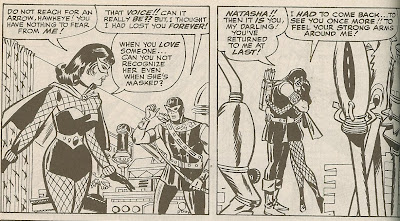
Lives of the Lovelorn: Hawkeye and the Black Widow

Both Clint and Natasha were introduced in the pages of Iron Man (well, Tales of Suspense in those days, which he shared with Captain America), both as villainous (or semi-villainous in the case of Hawkeye) characters.

Tony Stark always was more concerned about the Commies than a lot of Marvel's heroes--he began his Iron Man career in Viet Nam and, since at that time he was primarily a manufacturer of weapons, he had to deal with industrial espionage on top of the usual villainry. That's where the Black Widow came in, a Soviet spy sent to seduce Stark and learn his secrets. She had first gone in alone, and had been less than successful (although not about the seducation, which with Tony was pretty much a given in those days). So when she met Hawkeye and saw in him a potential ally to be used against Stark, she applied her techniques in his direction. Poor guy never had a chance.


Unfortunately for Natasha, she didn't do any better partnered with Hawkeye than she had alone--he took a shot at Iron Man, and his arrow bounced off of the armor and hit her.


Now, Natasha was a communist spy at this point in her career, but Hawkeye was not. In fact, he had taken on a costumed identity in order to fight evil (granted that he was first motivated by jealousy of Iron Man, but still his heart was always in the right place). So she had to convince him that she, as well, was on the side of good. Not that this was difficult, convincing Clint of what he wanted to think anyway...


...but on some level he really did realize what was going on.


At this point their love affair was interrupted, when Natasha--unsuccessful in completing her mission--was taken back to her home base by force.


But as she leaves the scene, the seeds of her eventual redemption are planted--she really does love Hawkeye, after all.


When next we see Natasha, she is in a costume given her by her superiors, who have given her an ultimatum: complete your mission or else.


And we're shown just what "or else" means (and given yet another reason to find her sympathetic).


When she asks him to help her against Iron Man once again, he's still reluctant, but--as usual--it doesn't take much for her to convince him.


However, it also doesn't take much for him to give up on the subsequent battle with Iron Man. He says it's all because he loves her so much, but I'm pretty sure that he didn't mind being given a way out of the fight.


However, Hawkeye's failure to complete his part of the mission apparently caused a break with the Widow, because the next time we see her is in the pages of The Avengers--again as a villainess but with some doubt in her heart.


And new-Avenger Clint also allows his emotions to get the better of him:


But in the end, all was well...


...at least for a while. Oh, sure, there were trust issues:


And, even as a "good guy" Natasha wasn't necessarily going to be Avengers material in that era:


And then there was her career as an agent (double-agent, even!) of SHIELD:


Even after the whole traitor storyline was over, there were issues. Such as the revelation of Natasha's husband:


Eventually, Natasha tried to quit the whole thing.


But that didn't work out so well for her, either.


And eventually she returned to spy work.


(Note that Hawkeye, on the whole, was far cooler about Natasha's SHIELD career than Captain America was about Sharon's.)


But Natasha appeared less and less often in the pages of The Avengers. Eventually the lovers were once again torn apart, and eventually it really would be the end.


The next time we see Natasha, all the years of deception--necessary or not--have come to a head:


I was actually pretty impressed, reading that last comic--published in the mid-1970s, which really takes it out of the Silver Age--that the emotional consequences of typical Silver Age romantic nonsense were being dealt with somewhat realistically--or at all!

I don't think she and Clint ever did discuss the particulars of their relationship (they didn't at that point, in any case), but there is, at least, a sense that there are consequences to actions--to the fact that as a villain she had preyed on the emotions of a needy man, and as a heroine she had treated him inconsistently at best due to her work, and that regardless of motive she had done him some damage and recognized this.

I haven't read the Black Widow mini yet, so I'm not sure how much is different about her current backstory, but--take away the Silver Age soft-focus lens--and here you've got a character who has not only really changed over time, she has become consciously self-aware. I'm not saying that any of that is likely to have stuck, or that she wouldn't make some of the same mistakes again--it's comics, after all, and even in real life habit is hard to break--but that's pretty cool.

Thursday, August 23, 2007

Silver Age Soap: Captain America

People say that in the past, comic book heroes were more stoic, solid heroic types who never let their personal problems get the better of them. They say that modern heroes are too prone to letting their emotions take over, to whining and moaning about every little thing. Possibly this is true if you're comparing today's comics to those of sixty years ago. However, forty years ago, during the Silver Age, heroes had plenty of drama, and many moments of anguished self-absorption. And Marvel's Stan Lee was the master of this Silver Age angst.

And no one had more of it than Captain America. First came Stan's decision to retroactively kill off sidekick Bucky, which led not only to guilt but to the constant fear of losing anyone else he might grow close to, particularly girlfriend Sharon Carter and new teenage sometime-partner Rick Jones. Add to that all the "man out of time" issues and a certain amount of normal trauma related to war memories, and Cap was a great candidate for any number of angst-laden monologues.

The biggest source of angst for Cap in the Silver Age, as indeed for Cap throughout most of his post-revival career, was of course the death of Bucky. And if Cap wasn't miserable enough due to his own obsessive thoughts, there were always plenty of opportunities to be reminded of it. For example, the many miles of newsreel footage featuring Cap and Bucky in action during the war.


And then there were the nightmares.


It didn't help much that Rick Jones was itching to take on the sidekick role. For a long time, Cap refused to let him wear the costume, although he did accompany him on a number of missions in civilian clothing. Here we see Rick giving Cap a piece of his mind, in an unusually astute analysis:


After this, Cap finally allowed Rick to don the costume and join him as a full partner, at least for a while.

Oh, I do have to mention that this wasn't the first time Rick tried this little trick. Several years earlier, in a remarkably similar scene, Rick had done exactly the same thing. Unfortunately for him, that time he wasn't quite as prepared for Cap's reaction.


When it wasn't Bucky (and, by extension, Rick) on his mind, Cap would worry about the safety of SHIELD-agent girlfriend Sharon.


And, just for a little variety, he would occasionally just angst about his place (or lack of one) in the modern era:


Yep, Silver Age Cap was seriously messed up. He did mellow some over time, and has by now regained a fair amount of his Golden Age stoicism. (Or had, before his recent death.) However, he still hadn't managed to solve what he knew even then was one of his biggest problems:

Thursday, May 03, 2007

Marvel fan days of my youth

So I was reading a few things on Bloglines today, and came across a link in Dick Hates Your Blog to this piece on politics in Marvel comics in the 8os, something I know pretty much nothing about. (I'm not writing about it today, either.)

Now, I had heard the name Vince Colletta before, on the splash page of god-only-knows-how-many comics I read as a kid and teenager, often with a bouncy adjective attached (ala "Jumpin' Jack Kirby" and "Stompin' Stan Lee").

That's another thing that made Marvel stand out to me when I was a kid--the personality. I don't remember ever noticing any credits on DC books I read, although I know they were there. But they weren't as dynamic as the ones on my Marvel books. And even after the nicknames disappeared from the credits, they were still all over the Marvel Bullpen Bulletin,* a page promoting upcoming projects, discussing editorial and creative-team changes in the company--as a twelve-year-old I certainly didn't read this closely but I did usually glance at it. I remember reading Stan's Soapbox, noting the way creators and their projects were referred to so effusively and so personally.

It all seemed so joyful, as if these people all went to work and had fun! And why not?--to a twelve-year-old, a job consisting of telling stories and drawing pictures would have been the ultimate good time. These must be the happiest people on the planet!

Yeah, I'm a grownup now. And it's been thirty years or thereabouts since I enjoyed that sort of blindness to the fact that any job is, well, a job. And I know that all the things I'm talking about--Stan's Soapbox, the goofy credits, etc.--were, really, business, promotion of an image. But I still have fond memories of being a young girl, looking forward to each month's new Fantastic Four, and feeling like the folks who made it had at least as much fun putting the book together as I did reading it.


* Of course I had to go out to the porch and grab an old Silver Age book out of the longbox. The one I took is from 1974, and one of the announcements on the Bullpen Bulletin Page is about the Invaders title; it'll give you an idea of the tone taken in these things:

ITEM: Let's roll out the red carpet for Free-wheelin' FRANK ROBBINS, Marvel's newest editor and bon vivant! As many of you know, Frank's the artist and writer of the newspaper comic strip "Johnny Hazard," and is considered by his peers to be one of the finest craftsmen in the business. Now, after cutting his incisors on a Morbius tale or two in the pages of ADVENTURES INTO FEAR, Frank has stepped in to give our pal SAL BUSCEMA a well-earned rest from the pages of CAPTAIN AMERICA--and to team up with Roy the Boy [Thomas] on a brand new 50 cent title due to debut early in '75. Its title? THE INVADERS! (Who's going to be in this newest, most exciting super-group? We'll leave you guessing for a month or so, pilgrim. Suffice it to say that we think the lineup of this liltin' legion is going to catch nearly everybody off guard, and that Free-wheelin' Frank will definitely have his hands full!)


Yeah, back in the day, long before the internet and the pages and pages of creator interviews and the 6 pages of previews of upcoming titles, this is what we had to whet our appetite for new books. Doesn't seem like much compared to, say, Newsarama, does it? :)

Wednesday, April 18, 2007

I want this and I want it bad.

Marvel is putting out Invaders Classic Volume 1, coming out in July.

240 pages of 1970s Invaders goodness.

And "Volume 1" means that there will be more.

Let the squealing commence.

Thursday, February 15, 2007

More Old School Supergirl

This looks to be the 70s-era Supergirl in a story entitled "Crypt of the Frozen Graves." In this tale Linda Danvers is trying her hand at the news business--officially she's a camera operator, but in her spare time writes freelance articles on organized crime, getting her information from a very frightened source.


Unfortunately the poor informant is discovered (and killed), and Linda has to seek out the information she wants using other means:


Better look fast--you won't see Supergirl in a revealing outfit like that again anytime soon...what's that?...ah...never mind.

In any case, Supergirl here displays that near-universal trait of the Silver Age superheroine--her execrable taste in men! One wonders as well about what she would consider a deal-breaker in a relationship. First-date groping? No problem. Criminal past? Just fine. Perfectly rational fear of bullets? Not acceptable!

But nothing to interrupt dinner over.

This, however, was...


Yes, it took endangering the lives of a restaurant full of innocent people to show Supergirl that this guy might not be Mr. Right.

And since this was the Silver Age, there's only one thing to do in this sort of situation. That's right--teach the lout a well-needed lesson!


However, the youthful Supergirl clearly hasn't yet fully developed her power of super-self-righteousness, because that lesson? Not quite what she was aiming for:


The rest of the story? Well, rest assured that there are in fact some frozen graves in this tale, and that Supergirl emerges triumphant at the story's end. Uncomfortable with the way in which her own actions as budding investigative reporter may have contributed to two deaths, she quits her job in an ethical huff, clearing the way for yet another new adventure in the next issue of her book.

And most important, Linda has learned a little lesson of her own:

Monday, February 12, 2007

Old School Supergirl

I recently came across an old (1980) digest-sized Supergirl comic called The Many Lives of Supergirl. It includes a number of old Superirl stories from various time periods, and none are identified by date--but I'm pretty sure the one I'm talking about here was a 60s or early-70s Supergirl. I'm not a Supergirl fan particularly, but folks on the comic internet have been talking so much about her lately that this story in particular stood out in contrast. It's about Supergirl's introduction to the world, after years spent keeping her super-ness secret from everyone while living her life as orphaned-and-adopted Linda Lee Danvers, and yeah, it's typical Silver Age. But I'm just going to let these images speak for themselves, all right?


Tuesday, November 28, 2006

Comics to Remember: Adventure #356, "The Five Legion Orphans" (1967) [Spoilers]

It's not a very large sample, but between this book and the Wonder Woman I discussed a few posts ago, I'd say that when I was five, a sure way to get me to buy a comic was to feature the regular characters turned into children. Or possibly that was a sure way to get my dad to pick that book to bring home to me, I don't recall. (Incidentally, the brown spots on the pics are from where the staples rusted over the years.)

In any case, here is Adventure 356, in 1967 the source for Legion of Superheroes stories. The story begins on Parents' Day, apparently a far more significant holiday in the 30th century, celebrated with parades and extensive media coverage of the parents of celebrities:


In the mean time, those Legionnaires without parents are stuck with monitor duty, and some are feeling a bit sorry for themselves, which isn't entirely unreasonable:


Suddenly the orphan Legionnaires are interrupted by a distress call from the planet Zinth. A valuable power crystal has been stolen by raiders and dropped into a pool of water. Mon-El and Superboy go search for the raiders (unsuccessfully) while Brainiac 5, Dream Girl and Element Lad don masks which will allow them to breathe underwater and go after the crystal. It's heavy, but the three manage to carry it out--until they find themselves growing weaker and are forced to drop it. When they emerge from the pool, it's apparent that they are only weaker because they are now younger, due to the effect of the water. Mon-El and Superboy return to find their friends transformed, and--assuming that they will be invulnerable to whatever is in the water--they go after the crystal themselves. Unfortunately they're wrong, and although they rescue the crystal, pretty soon they suffer the same fate as their companions. As toddlers they retain their powers, but not their memories--except for Brainiac 5 and his twelfth-level intellect.


They are immediately taken off to the Interstellar Orphanage. Please note the resemblance of the orphanage to a zoo--it seems designed for display more than anything else. (Also please note that Silver Age Brainy had a lot more respect for Dream Girl's powers than he has in his last few incarnations.)

Pretty soon the child-sized Leionnaires are on display as well, and the kids all try their best to get adopted by showing their abilities.


All are adopted and leave for their new homes. As for why Brainiac 5--who remembers who they all are!--doesn't tell anyone what happened, I can't figure out. Heck, he could have gotten back to his own lab and fixed 'em all. (I'll put it down to artistic license.) Instead, he sneaks into his new dad's lab to try to figure things out. This is not difficult, since apparently parenting on this planet doesn't involve anything resembling actually watching the kids. You'd think that someone who had just adopted a child would want to spend some time with him or her, but not here.


And that's a good thing for li'l Brainiac 5, because it enables him to save the day.


A "pleasant surprise"? Brainiac 5 is displaying his power of super-understatement here, I think...

As a kid, I don't think I thought much about it, but damn, this is a dark story. I can only imagine how it would be told today.